Breaking the BAA Compliance Dilemma in Healthcare Interoperability
1 Introduction
1.1 Cost reduction and efficiency improvement brought about by automation
In the US healthcare system, patient visits and health insurance claims are essential needs. Prior authorization (PA) is a routine process between healthcare institutions and insurance payers. Taking PA as an example, the underlying data interaction between healthcare payments and prior authorization in the US currently largely relies on the X12 EDI standard, which has long suffered from pain points such as fragmented processes, high dependence on manual intervention, and high operating costs.
According to data from Healthcare IT News in April 2026, “TPA pre-authorization is only 29.5% fully automated, with over 70% still stuck in manual processes.” It still relies on web forms, faxes, emails, and telephones for manual processing. A large amount of administrative manpower is consumed in data entry, format proofreading, data supplementation, and manual matching and review, which significantly increases the operating costs of clinics, TPAs, and payers.
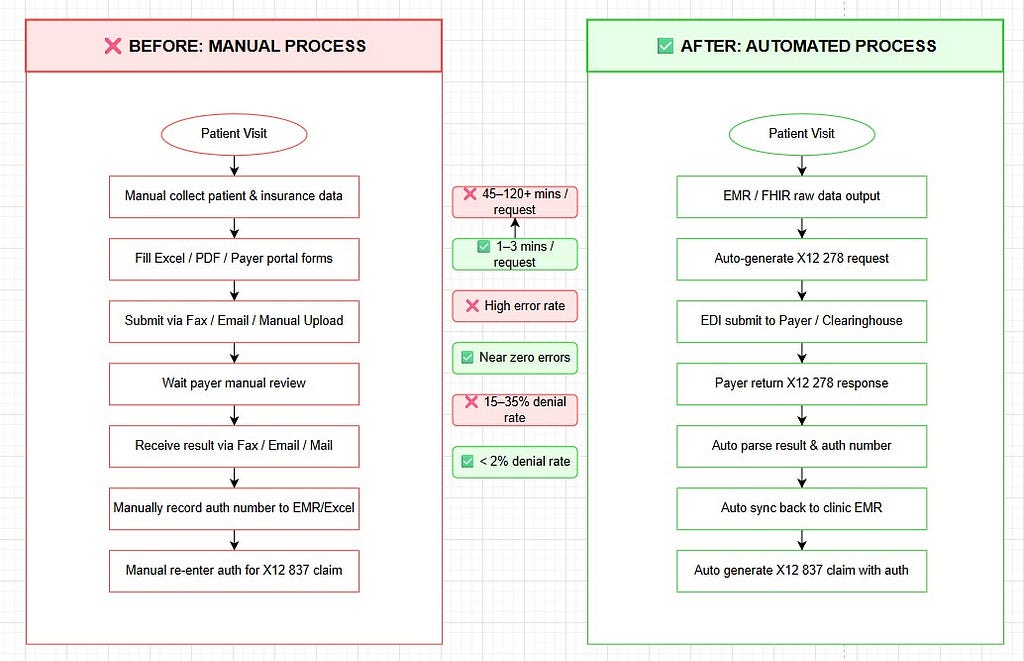
Taking PA (Power Actuator) as an example, compared to manual PA, automated PA offers significant advantages in cost reduction and efficiency improvement. According to the CAQH 2025 Index Report released in January 2026 and the revised CMS-0057-F in 2026, the following information is available:
1. Efficiency Enhancement Dimensions: Time and Processing Efficiency
- Processing time is drastically reduced: the processing time for a single PA request is reduced from 45–120+ minutes in manual mode to 1–3 minutes in automated mode.
- Error rate vs. accuracy: Manual processes are accompanied by high error rates, while automated processes can achieve error rates close to zero.
- Synchronous automation of processes: The automated process realizes a closed loop of the entire chain from EMR data output to the generation, sending, parsing of X12 278 results, synchronization back to the medical record system, and subsequent generation of X12 837 claims, without the need for manual intervention.
2. Cost Reduction Dimension: Financial and Administrative Expenses
- Direct administrative cost savings: According to the CAQH 2025 Index report, healthcare organizations can save an average of $16.42 in real administrative costs by processing each PA transaction electronically.
- The denial rate has dropped significantly:
- Manual mode: The chargeback rate due to incomplete or delayed information is as high as 15–35%.
- Automated mode: The chargeback rate can be reduced to below 2%.
- Compliance risk avoidance: The automated system has built-in SNIP verification and HIPAA masking, which can effectively avoid the risk of penalties of up to $1,000+ per day from CMS for non-compliance.
Therefore, 1. Prior Authorization is a high-frequency requirement, and 2. Automation can effectively address this. Cost reduction and efficiency improvement in the PA process.
1.2 A New Era of Dual-Track Operations with X12 and FHIR
The mandatory interoperability compliance requirement for CMS 2027 is about to be implemented, requiring all medical insurance payers to launch a standardized FHIR open API by 2027 to meet compliance requirements such as patient data access, inter-institutional verification, and electronic pre-authorization. After the policy is implemented, the industry is unlikely to eliminate traditional X12 EDI, but rather will likely form a permanent dual-track system where X12 handles backend claims settlement and FHIR handles external open interoperability. Under this dual-track model, the bidirectional standardization conversion between X12 and FHIR transforms from a phased transitional need into a rigid requirement for the long-term operation of medical services.
1.3 Market Pain Points
As described in sections 1.1 and 1.2, conversion between X12 EDI and FHIR formats remains a frequent scenario. According to the 2026 Q2 Administrative Efficiency Pulse Survey, Gartner Market Guide for Healthcare Integration Engines, KLAS Research, and WEDI reports, how are payers, TPAs, and RCMs currently handling this conversion issue?
There are three main approaches, and all of them have obvious pain points:
Manual/semi-manual conversion (the largest proportion, approximately 50–60% of small and medium-sized TPAs and Providers)
1. Mapping can be completed using Excel, web forms, scripts, or manual input.
Problems: Extremely low efficiency (a single PA often takes 45–120 minutes), high error rate (15–35% chargeback rate), and high labor costs.
2. Traditional middleware/integration engines (Rhapsody, Cloverleaf, InterSystems Ensemble, etc.)
This is the mainstream choice for large payers and some TPAs.
The licensing fees are high (annual fees often reach hundreds of thousands of US dollars), the implementation cycle is long (3–9 months), and it is not adaptable to complex non-standard X12. In addition, it usually requires PHI data to be uploaded to the server, and a BAA agreement must be signed, which increases legal risks and compliance costs.
3. Cloud vendors or general conversion tools (Microsoft FHIR Converter, AWS, etc.)
Advanced technology, ready to use right out of the box.
The system lacks sufficient support for complex X12 loops and Payer-specific business rules. PHI data must be uploaded to the cloud, triggering BAA requirements, and customization costs are high.
In summary, the core contradiction at present lies in:
Payer, TPA, and RCM require scalable and flexible X12 ↔ FHIR conversion capabilities, while also wanting to prevent PHI data from leaving their own environment (to avoid BAA legal liability and data breach risks). Existing solutions cannot simultaneously meet the four requirements of “security, flexibility, efficiency, and low cost”.
More specifically, the market needs a solution to resolve a seemingly contradictory problem:
How can we ensure that PHI remains with the user (Payer/RCM/TPA)? At the same time, how can the technology service provider safeguard its core business logic?
2. Technical Solution: WASM-Driven Local Priority Transformation Engine
2.1 Architecture Overview
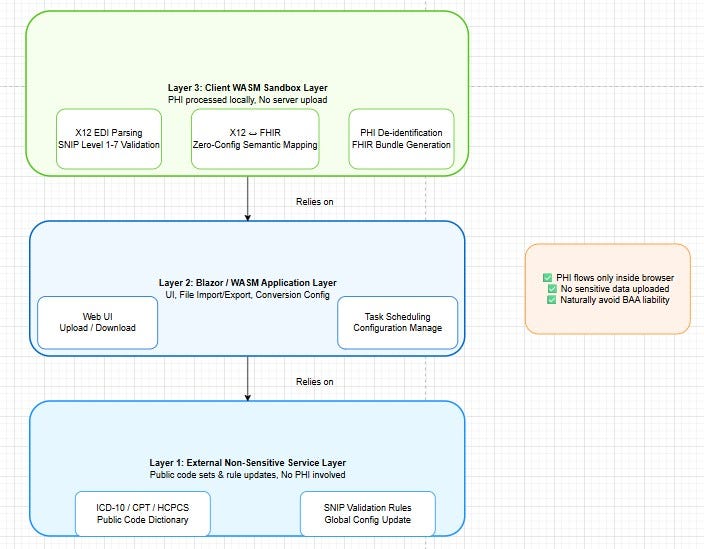
The architecture diagram above clearly illustrates the three-layer isolation design:
- Client browser (WASM sandbox layer): All PHI data processing and transformation logic is completed here, and the data never leaves the browser environment;
- Blazor/WASM application layer: provides user interface, file import/export, conversion configuration and other functions, and only interacts with the WASM engine;
- External non-sensitive service layer: only loads non-PHI data such as public coding dictionaries (e.g., ICD-10, CPT) and verification rule updates, and does not involve any sensitive patient information.
- Key design features: PHI data circulates only within the browser sandbox and is never uploaded to any server, physically cutting off the source of data leakage and compliance verification.
2.2 Core Technology Design (Addressing the three major pain points of “security + compliance + intellectual property”)
(1) WASM Sandbox: Creates a processing environment where data does not leave the client.
- The core logic of the conversion engine is compiled into a WASM binary file, which runs in the browser’s isolated sandbox and cannot directly access the local file system or network.
- All PHI data (such as patient name, ID, and diagnostic information) is processed only in memory. After conversion, FHIR files are generated directly for download, and no data is left on the server side.
- This architecture completely changes the boundaries of legal liability: the service provider is not involved in the processing and transmission of PHI, and therefore is not considered a BA and does not need to sign a BAA agreement.
(2) Encrypted memory loading: Protects proprietary mapping logic from being leaked
- The core X12↔FHIR mapping rules and SNIP verification logic are encrypted and stored. During WASM engine initialization, they are only decrypted in memory and are not exposed in plaintext.
- The browser cannot directly access the decryption logic in WASM memory, thus avoiding reverse engineering and intellectual property leakage.
- There is no need to upload core rules to the server, nor is there a need to store plaintext configuration files on the client, thus balancing security and maintainability.
(3) Full-process compliance verification: standardized processing from data import to output
The engine has a complete built-in compliance processing flow and does not rely on external services.
- PHI identification and desensitization: Automatically identifies sensitive fields (such as name, ID number, and contact information) in X12 messages, and supports configurable mask desensitization rules;
- SNIP Level 1–7 Validation: Built-in X12 message validation rules automatically perform syntax, data type, and business logic validation, and intercept unqualified messages in advance.
- Semantic mapping conversion: Based on industry standard fixed semantics, it realizes automatic mapping from X12 core segments (278/837/834) to FHIR resources without the need for manual maintenance of field configuration.
- Output standardization: Generates a Transaction Bundle that conforms to the FHIR R4 standard, which can be directly imported into the FHIR server without secondary processing.
3. Practical Value and Effect Verification: The Realistic Significance of WASM Local-First Architecture
The WASM-driven local-first architecture is not a clever theoretical design, but a precise solution to a long-standing pain point in the field of medical interoperability.
In high-frequency scenarios such as Prior Authorization and Claims processing, the data transformation stage is consistently the point where efficiency, error rates, and compliance risks are most concentrated. Traditional solutions either sacrifice efficiency and cost or data security and legal compliance. The WASM local-first solution, however, demonstrates significant advantages in the following dimensions:
3.1 Efficiency and Cost Improvement
By offloading the conversion logic entirely to the browser, the processing time for a single X12 278 preauthorization request can be reduced from the traditional 45–120+ minutes to 1–3 minutes. Simultaneously, by eliminating server round-trip and manual intervention, overall administrative costs can be reduced by approximately 70–80% (based on CAQH data estimates).
3.2 Fundamental reduction in compliance risk
The core value lies in eliminating the risk of PHI data leakage at its source. Because all sensitive data processing occurs within the user’s local browser sandbox, the technical service provider never comes into contact with PHI and therefore does not constitute a Business Associate (BA) under the law, thus requiring no BAA agreement. This directly solves the most troublesome legal and negotiation obstacles for payers and TPAs when introducing third-party tools.
3.3 Balancing Intellectual Property Protection and Flexibility
By employing encrypted memory loading and dynamic rule injection mechanisms, the technology team can provide customized rule updates for different Payers without exposing the core mapping logic. This design protects trade secrets while maintaining high product maintainability.
3.4 Verifiable security boundaries
- The data’s entire lifecycle exists only in browser memory and local files.
- There is no server-side data persistence.
- Supports full SNIP level 1–7 checksums and configurable PHI de-identification strategies;
- It complies with HIPAA’s “Minimum Necessary” principle and the highest compliance requirements of “data not leaving the domain”.
This architecture is of great practical significance during the mandatory CMS interoperability window of 2026–2027. It enables small and medium-sized TPAs and regional payers to quickly obtain enterprise-level X12↔FHIR conversion capabilities at a lower cost and with less legal risk.
4. Conclusion
Given the long-standing industry reality of X12 and FHIR operating in tandem, data format conversion has become an unavoidable and frequent necessity in the healthcare payment process. Traditional solutions consistently struggle to balance security, cost, efficiency, and compliance, while a WASM-based local-first architecture offers a viable new path.
This proves that, under strict HIPAA regulations, it is entirely possible to achieve both “PHI data not leaving the user’s environment” and “the technical service provider protecting trade secrets” through reasonable client architecture design.
This solution not only helps payers and TPAs meet CMS 2027 compliance requirements more quickly, significantly reduce operating costs and chargeback rates, but also provides the entire industry with a low-risk, highly flexible, and low-deployment-barrier interoperability infrastructure approach.
Looking ahead, we welcome Payers, TPAs, RCM teams, integrators, and other technology professionals interested in healthcare data security and interoperability to join us in exploring the application and implementation of on-premises-first architectures in more scenarios. We believe that through continuous technological innovation and compliance practices, the flow of healthcare data will become more secure, efficient, and controllable.
Demo and Discussion
The X-Bridge project is a practical implementation of this architecture, solving the conversion problem between X12 and Payer FHIR. Interested parties are welcome to contact us to arrange a demo or discuss business cooperation.
References
- CMS (Centers for Medicare & Medicaid Services): Quarterly Interoperability Compliance Progress Report, Published May 2026.
- CAQH (Council for Affordable Quality Healthcare): Q2 2026 Administrative Efficiency Pulse Survey, Released April 2026.
- Gartner: Market Guide for Healthcare Interoperability Middleware: Mid-Year Update, Published May 2026.
- Healthcare IT News: TPA Compliance Readiness Index: 8 Months to Deadline, Published April 15, 2026.